APPLIED CURRICULUM / 01 OF 01
One engineering change, through a harness
The exciting part isn't an agent writing code or CAD on its own. It's an agent carrying one bounded change through your toolchain and handing back evidence a responsible engineer can approve.
Turn one real engineering change request into a harness map: pinned baseline, scoped tools, dependency-aware checks, an independent review, a named approval gate and a recorded decision. Then measure it against your current baseline.
01 / WHAT THE SOURCE SHOWS
What the demo actually shows
The full source clip is presented in two consecutive chapters. Watch both in order; no content is omitted.
Chapter 1 of 2 · 00:00–05:00
Chapter 2 of 2 · 05:00–09:43
Cat Wu (Product Manager, Claude Code), Code with Claude opening keynote, 22 May 2025: a table feature for Excalidraw goes from one prompt to plan, diffs, lint and tests, manual check, pull request and a docs update via GitHub Actions. About 90 minutes of agent work, sped up for the stage. Strongest short evidence: diffs, approval modes, lint/tests and the 90-minute disclosure, around 04:43–05:46 in this clip. The complete original clip is split into two consecutive playback chapters. Timecodes refer to the original unsplit clip.Video: Anthropic, Code with Claude opening keynote (22 May 2025), segment presented by Cat Wu. Clip as reposted on X by @0xbelial on 3 Nov 2026. Original audio and credits unchanged.
The supporting clip is Cat Wu, Product Manager for Claude Code, at Anthropic's Code with Claude opening keynote on 22 May 2025. She gives Claude Code one prompt: add a long-requested table component to the existing open-source Excalidraw repository, with custom dimensions, drag-to-resize and the existing styling options. On screen, Claude Code writes a to-do plan, explores the codebase and proposes edits as visible diffs. A human can approve each diff or switch to auto-accept. In the demo the agent was allowed to edit, run lint and tests, and open pull requests. Cat states that the task took about 90 minutes of agent work, shown sped up on stage. The agent iterated until lint and tests passed. The feature was then checked by hand in the running app, a pull request was opened through the GitHub CLI, and a reviewer's request on the PR triggered Claude Code in a GitHub Action to update the docs. She also mentions customers running many Claude Code instances in parallel for flaky tests, test coverage and on-call triage. Her comparison with days of manual work is a presenter's claim, not a controlled benchmark.
This is software work on a public repository. Everything below that maps the pattern onto CAD, PLM, simulation, test evidence and change boards is our proposed application, not something Anthropic or the speaker claimed. The repost that circulated on 3 November 2026 attributes quotes about 'self-improving loops', 'agentic graphs' and the end of prompting to an 'Anthropic engineer' and names a newer model. None of that is in this keynote section, and we don't use it.
The workflow below is our applied engineering interpretation of the source.
02 / MAKE IT WORK
Same pattern, real engineering: a bracket material change
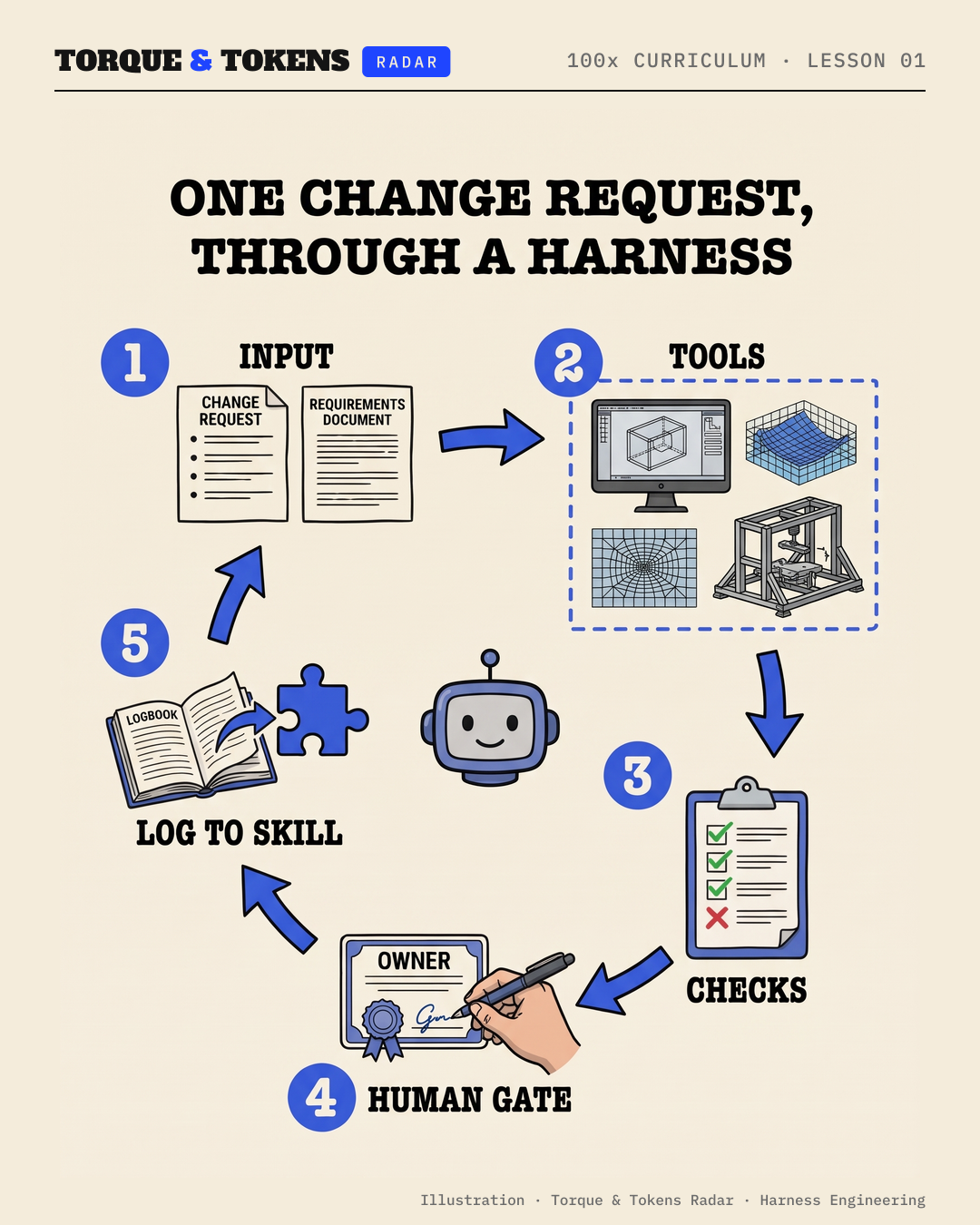
A seemingly small change, a mounting bracket moving to a different material, crosses a requirements tool, a CAD model, a PLM revision, a simulation setup, a supplier datasheet, a test report and several approval owners. The engineering itself is only part of the wait. Finding the right versions and reconstructing earlier decisions eats the rest. Here is that change carried through a harness. The agent prepares a verifiable change packet. It never approves the design by writing a confident summary.
01Define the work unit and pin the baseline+
- Input
- The change request: bracket part number, current and proposed material, reason for change, affected configuration and release owner.
- Agent action
- The agent writes a plan, then resolves part revision, BOM effectivity, CAD configuration, load cases, solver version, material allowables and test-data version into a work manifest.
- Output
- Work manifest with every source ID, plus an explicit list of unresolved conflicts (e.g. PLM says revision C, supplier PDF describes revision B).
- Engineering check
- The responsible engineer confirms scope and baseline before any tool runs. Any version conflict stops that branch and is surfaced, never guessed around.
02Give the agent bounded tools+
- Input
- The approved manifest.
- Agent action
- The agent reads requirements and PLM through existing interfaces, exports CAD properties in a controlled branch, launches approved analysis scripts and retrieves test results. Every tool has a schema, units, permitted inputs, a timeout and an output artifact.
- Output
- Proposed geometry and property changes in a working revision. The released model stays untouched.
- Engineering check
- The permission list is explicit and reviewed: read, edit-in-branch, or human-only. In the demo the agent could edit, run lint and tests and open PRs.
03Run the checks along real dependencies+
- Input
- Proposed change plus manifest.
- Agent action
- Independent work runs in parallel (requirements, supplier limits, test evidence) and joins on the same part and revision before analysis. Geometry validity, units, mass, clearance and interface checks run independently. Fatigue waits for the correct stress result. Failed runs retry within set bounds.
- Output
- Before/after results, solver convergence and margin checks against defined criteria, logs of failed attempts.
- Engineering check
- A CAD file opening isn't acceptance. Pass/fail criteria belong to the responsible discipline, and simulation guides the investigation but does not replace qualification testing. In the demo the agent iterated until lint and tests passed and a human then tried the feature.
04Independent review, then an explicit gate+
- Input
- Change packet: changed properties, results, open assumptions, failed attempts.
- Agent action
- A separate checker compares the proposal with the acceptance criteria and known failure cases, without reusing the generator's explanation. The gate names its owner, the required evidence and the permitted next action. Evidence gathering can continue while the decision waits.
- Output
- Review findings and a decision record: decision, rationale, revision, time, signer.
- Engineering check
- One named owner decides, the agent never invents an approval, and signing authority stays visible. In the demo every edit appears as a diff and review requests on the PR trigger the next agent run.
05Close the loop and learn from the miss+
- Input
- The approved decision, plus anything that went wrong on the way.
- Agent action
- After authorised approval, the agent creates the controlled change in the system of record with traceable links, evidence and a rollback path. If a stale drawing or a wrong unit caused a failure, that case goes into an evaluation set and the tool contract or playbook is revised.
- Output
- Released change with an evidence trail, plus a versioned harness update.
- Engineering check
- Nothing quietly edits a released model, machine program or production parameter. Held-out past cases are rerun after a harness change. A revised playbook is not model training and comes with no guarantee.
03 / MAP IT TO YOUR REALITY
Choose your engineering context.
A sensor or bracket revision touches requirement IDs, interfaces, CAD, the PLM BOM, regression tests and ASPICE/functional-safety work products, each in a different tool with a different owner.
- Apply it
- The agent prepares a change-impact packet: affected requirement IDs, interface changes, mass and clearance checks, linked regression tests and a list of missing evidence.
- Who approves
- Design/release owner and the change control board, plus customer or supplier sign-off where the part is shared.
- Evidence to keep
- Traceability links, regression results and the open-gaps list attached to the change request, with every agent action logged.
Strict configuration management. A drawing change ripples into analysis reports, load-case assumptions and the verification matrix before anyone can review it.
- Apply it
- The agent traces the drawing change into the analysis and verification matrix and prepares the review package. The regulated decision stays with people.
- Who approves
- Authorised engineering reviewers and the configuration control board, plus quality and certification review.
- Evidence to keep
- Pinned configuration, load-case assumptions, analysis diffs and verification gaps in one configuration-controlled package.
Controlled data in restricted environments, requirements and test records spread across programmes, and security review on top of engineering review.
- Apply it
- Inside the permitted environment, the agent prepares a requirements-to-test discrepancy review with exact requirement and test IDs, provenance and unresolved contradictions.
- Who approves
- Programme/design authority and the configuration control board, plus security and export-control review.
- Evidence to keep
- An access-scoped artifact set with a complete audit log of every tool call and data access.
A recurring quality deviation needs lot, machine and tool history from MES, measurement data and the PFMEA before anyone dares to change the process.
- Apply it
- The agent assembles lot, machine and tool versions with the measurement evidence, tests the hypotheses against the data, and proposes a trial with a rollback plan.
- Who approves
- Process owner and quality owner, plus the production lead for the trial run.
- Evidence to keep
- Data extracts with their versions, hypothesis results, the trial plan and the trial-run record.
04 / TAKE IT TO WORK
Run a 10-change harness pilot
A one-page harness map plus a pilot scorecard for 10 changes: baseline vs harness on the same rubric, with scope and failures stated.
Keep these ideas.
- The prompt is one line. The harness around it (pinned baseline, bounded tools, real checks, independent review, a named gate) decides whether the work survives review.
- Stop on version conflicts. An agent that guesses between revision B and C creates rework, not speed.
- Fan out only where work is truly independent, and join on the same part and revision. Three useful branches beat a hundred duplicated agents.
- Hand over evidence, including failed attempts and open assumptions, not just a confident result.
- Approvals become explicit states with an owner, required evidence and a permitted next action. Committees don't vanish, but the time spent preparing for them can shrink.
- Every miss becomes a test case. Rerun held-out past changes whenever the harness changes.
- '100x' is something you measure on your own changes, against a baseline. It is not a slogan.
05 / FOLLOW THE SOURCE